
Can Acupuncture Help TMJ Pain? What Clinical Research Shows
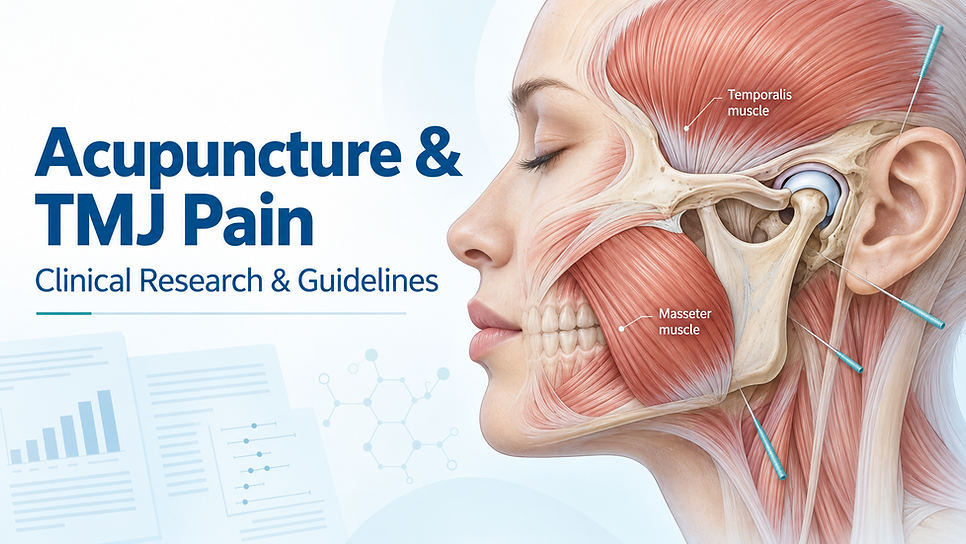
Evidence From a BMJ Review of 233 Reports, Clinical Guidelines, and Acupuncture Meta-Analysis
By Balance Art Acupuncture | Published October 22, 2026
Understanding TMJ Pain and Jaw Disorders
TMJ pain is a common term patients use to describe discomfort affecting the jaw joint and surrounding muscles.
The temporomandibular joint (TMJ) connects the lower jaw to the skull. Conditions affecting this joint and the surrounding chewing muscles are medically known as temporomandibular disorders (TMD).
Although medical researchers often use the term TMD, most patients are more familiar with TMJ. Throughout this article, we use TMJ pain when discussing patient symptoms and TMD when referring to the clinical conditions studied in published research.
TMJ-related symptoms can affect much more than eating or speaking. Everyday activities such as chewing, yawning, talking, and opening the mouth may become uncomfortable or difficult.
Common symptoms include:
-
Pain or tenderness around the jaw and temples
-
Tightness or soreness in the chewing muscles
-
Difficulty opening the mouth comfortably
-
Pain when chewing or yawning
-
Jaw clicking or popping, sometimes accompanied by pain
-
Headaches or associated neck discomfort
For patients seeking non-drug approaches to chronic jaw pain, acupuncture has become an increasingly studied treatment option.
Recent clinical research and international guidelines provide valuable insights into how acupuncture may support jaw function and symptom management.
Key Takeaways
-
A major 2023 BMJ systematic review evaluated 233 reports representing 210 independent randomized trials of treatments for chronic TMD pain. Of these, 153 trials involving 8,713 participants contributed to the network meta-analysis.
-
Acupuncture was among the interventions supported by moderate-certainty evidence for improving physical functioning.
-
The estimated absolute benefit for achieving clinically meaningful functional improvement was 42 percentage points compared with placebo or sham treatment.
-
A separate 2023 systematic review of acupuncture trials found improvements in certain TMD-related pain outcomes, including when acupuncture was added to other treatments.
-
An international BMJ clinical practice guideline conditionally recommends acupuncture as one treatment option for chronic TMD pain.
Together, these findings suggest that acupuncture may have a meaningful role within a comprehensive, conservative approach to chronic TMJ-related symptoms.
What Did the Major 2023 BMJ Review Find?
In December 2023, The BMJ published Management of Chronic Pain Secondary to Temporomandibular Disorders: A Systematic Review and Network Meta-Analysis of Randomised Trials.
This extensive review evaluated 233 reports representing 210 independent randomized clinical trials investigating different approaches to chronic pain associated with temporomandibular disorders.
Among these, 153 trials involving 8,713 participants were included in the network meta-analyses.
The researchers compared 59 treatments or treatment combinations, examining outcomes such as pain relief, physical functioning, emotional wellbeing, sleep, and adverse events.
Rather than relying on a single clinical trial, the researchers used a network meta-analysis to compare evidence across multiple treatment options. One important finding concerned acupuncture and physical function.
Can Acupuncture Improve Jaw-Related Function?
One of the most clinically relevant findings was that acupuncture showed benefits for physical functioning in patients with chronic TMD.
The BMJ analysis found moderate-certainty evidence that acupuncture probably improved physical functioning compared with placebo or sham procedures.
The estimated risk difference for achieving a clinically meaningful improvement was 42 percentage points (95% confidence interval: 33–50 percentage points).
This result refers to the additional proportion of patients estimated to achieve a meaningful improvement in the study’s physical-function outcome, rather than a 42% reduction in pain. The threshold was a five-point improvement on the SF-36 physical component summary score, a general physical-health measure.
For people living with chronic TMJ-related pain, physical function matters because symptoms may interfere with eating, speaking, and other routine activities. The findings suggest that acupuncture may contribute to improved physical functioning as part of a broader treatment approach.
What Do Clinical Guidelines Say About Acupuncture for TMJ Pain?
Alongside the systematic review, The BMJ published an international clinical practice guideline: Management of Chronic Pain Associated With Temporomandibular Disorders: A Clinical Practice Guideline.
The guideline was developed by an international panel of clinicians, researchers, methodologists, and patients. It examined conservative treatments, medications, and invasive procedures for people experiencing chronic TMD-related pain lasting at least three months.
The guideline issued a conditional recommendation in favor of acupuncture. This means acupuncture is considered a reasonable treatment option for appropriate patients, taking into account individual circumstances, preferences, and the availability of other treatments.
The guideline also strongly recommended several approaches emphasizing movement, function, and self-management, including supervised jaw exercises, therapist-assisted mobilization, and manual trigger point therapy.
For patients, the message is encouraging: acupuncture can be considered within an evidence-informed treatment plan rather than as an isolated intervention.
What Does Acupuncture-Specific Research Show?
A separate 2023 systematic review focused specifically on acupuncture for temporomandibular disorders. Published in Medicine, the study was titled Is Acupuncture an Effective Treatment for Temporomandibular Disorder?: A Systematic Review and Meta-Analysis of Randomized Controlled Trials.
The researchers reviewed 32 randomized trial reports, with 22 included in quantitative analysis. The abstract reports 471 participants; participant totals differ across the review’s individual comparisons.
They examined acupuncture compared with different control treatments and acupuncture used alongside other therapies. The analysis found favorable results for several TMD-related outcomes.
In one randomized trial involving 40 participants, acupuncture used alongside another treatment was associated with a greater reduction in pain intensity: mean difference −1.23 (95% confidence interval −1.79 to −0.67).
This result comes from an individual trial reported in the review, rather than a pooled estimate from multiple trials. The researchers also reported improvements in other treatment-response measures.
Although the included trials varied in quality and methodology, and evidence certainty was low to very low, the findings support further consideration of acupuncture as an adjunctive treatment for TMJ-related pain.
How Might Acupuncture Help TMJ-Related Symptoms?
TMJ-related disorders often involve a combination of joint-related symptoms, chewing-muscle pain, muscular sensitivity, and changes in how the nervous system processes pain.
Acupuncture has been investigated for its potential effects on pain modulation and neuromuscular function. Possible therapeutic pathways being studied include:
Pain Modulation
Acupuncture may influence nervous-system pathways involved in processing pain signals.
Muscle-Related Discomfort
Acupuncture may help manage pain associated with sensitive or tense chewing muscles.
Physical Function
By helping manage symptoms, acupuncture may support participation in jaw exercises and other conservative care.
Stress-Related Symptoms
Because stress and jaw clenching can coexist with TMJ-related disorders, individualized treatment may also address associated tension and wellbeing.
Local Circulation and Soft-Tissue Function
Potential effects on local microcirculation and surrounding soft-tissue function are also areas of research interest.
These proposed mechanisms may help explain how acupuncture contributes to symptom relief and functional improvement in selected patients; they do not establish structural repair of the joint.
What About Jaw Clicking, Locking, or Limited Mouth Opening?
Jaw clicking, popping, and restricted movement are among the symptoms that patients commonly associate with TMJ problems. These symptoms may arise from different causes, including muscle tension, altered jaw mechanics, or joint-related conditions.
In our clinical experience, some patients report reduced jaw-muscle tension, more comfortable jaw movement, improved mouth opening, and less painful clicking following acupuncture treatment.
Acupuncture may help through pain modulation, relaxation of the chewing muscles, and improvements in the functional condition of the surrounding soft tissues.
For patients whose symptoms are primarily associated with muscle tension and pain, acupuncture may be a valuable conservative treatment option. Persistent mechanical locking or significant structural joint problems require an individualized approach based on an appropriate diagnosis.
What Does This Research Mean for Patients?
For patients experiencing chronic TMJ-related pain, the research offers several practical insights.
First, acupuncture has been evaluated within a large body of randomized clinical research on chronic TMD. Second, the BMJ network meta-analysis identified acupuncture as one of the treatments with moderate-certainty evidence for improving physical functioning.
Third, acupuncture-specific trials suggest that treatment may help manage pain, particularly when integrated with other conservative approaches. Finally, an international clinical practice guideline recognizes acupuncture as a treatment option that may be appropriate for selected patients.
These findings support a patient-centered approach in which treatment is selected according to symptoms, diagnosis, functional limitations, and individual preferences.
Our Perspective
At Balance Art Acupuncture, we view acupuncture as one possible component of conservative care for chronic TMJ-related pain and jaw-muscle discomfort. Balance Art Acupuncture is located in Vienna, Virginia, and welcomes patients from Reston, Tysons Corner, McLean, Fairfax, Falls Church, Arlington, Great Falls and Chantilly in Northern Virginia, as well as Potomac and Bethesda in Maryland, Washington, DC, and surrounding communities.
The 2023 BMJ research is particularly meaningful because it evaluates patient-important outcomes such as physical function, rather than focusing only on temporary symptom relief.
The accompanying clinical guideline also provides a useful framework for considering acupuncture alongside jaw exercises, manual therapy, patient education, and other conservative approaches. Our treatment philosophy emphasizes individualized assessment, symptom management, and support for daily function.
For patients experiencing jaw pain together with neck tension or headaches, care can also consider associated musculoskeletal symptoms while recognizing that these complaints may have different underlying causes.
Acupuncture is not a replacement for appropriate dental, orofacial pain, or medical evaluation when structural joint problems or other conditions are suspected. Learn more about our acupuncture approach to pain management.
Considering Acupuncture for TMJ Pain in Northern Virginia?
If you’re experiencing chronic jaw pain, muscle tension, painful clicking, or TMJ-related discomfort, acupuncture may be a conservative treatment option worth considering.
At Balance Art Acupuncture in Vienna, Virginia, we provide individualized acupuncture care for patients experiencing TMJ-related pain and other musculoskeletal conditions.
Balance Art Acupuncture is located in Vienna, Virginia, and welcomes patients from Reston, Tysons Corner, McLean, Fairfax, Falls Church, Arlington, Great Falls and Chantilly in Northern Virginia, as well as Potomac and Bethesda in Maryland, Washington, DC, and surrounding communities.
Our treatment approach focuses on managing pain, reducing jaw-muscle tension, improving comfort, and supporting everyday jaw function.
Whether you’re dealing with persistent jaw discomfort, muscle tightness, or difficulty opening your mouth comfortably, our team can help you explore an individualized treatment plan.
Learn More About TMJ Acupuncture Treatment
Frequently Asked Questions
Can acupuncture help TMJ pain?
Clinical research suggests acupuncture may help some people with temporomandibular disorders, particularly with physical functioning and certain pain outcomes. A 2023 BMJ guideline conditionally recommends acupuncture as an option for chronic TMD pain.
Is TMJ the same as TMD?
TMJ stands for temporomandibular joint, the joint connecting the jaw to the skull. TMD refers to disorders involving this joint, the chewing muscles, and related structures.
Can acupuncture help jaw muscle tension?
Acupuncture may be considered for pain associated with tense or sensitive jaw muscles. Treatment should be individualized, particularly when clenching, dental conditions, or other factors contribute to symptoms.
Can Acupuncture Help Jaw Clicking or Locking?
Yes. Acupuncture may help improve jaw clicking, muscle tension, and restricted jaw movement in some patients with temporomandibular disorders (TMD), particularly when symptoms are associated with muscle tightness and pain-related dysfunction.
In our clinical experience, some patients report reduced tension in the surrounding jaw muscles, more comfortable jaw movement, improved mouth opening, and less painful clicking following acupuncture treatment.
Acupuncture may help through pain modulation, relaxation of the masticatory muscles, and improvements in the functional condition of the soft tissues surrounding the temporomandibular joint. Potential effects on local microcirculation are also being investigated.
For patients whose symptoms are primarily associated with muscle tension and pain, acupuncture may be a valuable conservative treatment option. Persistent mechanical locking or significant structural joint problems require an individualized approach based on an appropriate diagnosis.
Can TMJ problems cause headaches or neck pain?
TMJ-related disorders can coexist with headaches and neck discomfort. However, these symptoms may have other causes, so evaluation is important when symptoms are persistent or unusual.
Is acupuncture a replacement for dental or physical therapy treatment?
No. Acupuncture can be considered as part of a broader conservative treatment plan, which may include dental assessment, jaw exercises, physical therapy, and other appropriate care.
Where Can I Find Acupuncture for TMJ Pain Near Vienna, VA?
Balance Art Acupuncture is located in Vienna, Virginia, and welcomes patients from Reston, Tysons Corner, McLean, Fairfax, Falls Church, Arlington, Great Falls and Chantilly in Northern Virginia, as well as Potomac and Bethesda in Maryland, Washington, DC, and surrounding communities. Our clinic offers individualized acupuncture care for TMJ-related jaw pain, muscle tension, and associated discomfort.
Explore more evidence in our Research & Insights library and chronic low back pain research.
For related clinical care, visit our treatment directory.
References & Original Sources
1. Yao L, Sadeghirad B, Li M, et al. Management of Chronic Pain Secondary to Temporomandibular Disorders: A Systematic Review and Network Meta-Analysis of Randomised Trials. BMJ. 2023;383:e076226. DOI: 10.1136/bmj-2023-076226. PubMed.
2. Busse JW, Casassus R, Carrasco-Labra A, et al. Management of Chronic Pain Associated With Temporomandibular Disorders: A Clinical Practice Guideline. BMJ. 2023;383:e076227. DOI: 10.1136/bmj-2023-076227. Original Guideline.
3. Park EY, Cho JH, Lee SH, Kim KW, Ha IH, Lee YJ. Is Acupuncture an Effective Treatment for Temporomandibular Disorder?: A Systematic Review and Meta-Analysis of Randomized Controlled Trials. Medicine. 2023;102(38):e34950. DOI: 10.1097/MD.0000000000034950. PubMed · PMC — Free Full Text.